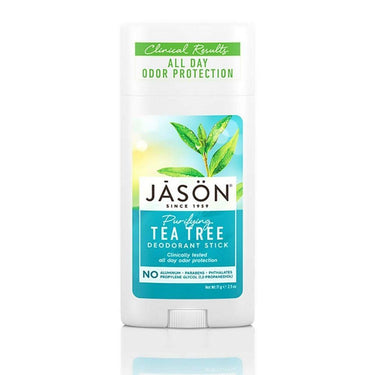

Jason Tea Tree Oil Deodorant 2.5oz
 Jason Tea Tree Oil Deodorant 2.5oz
$8.39
/
Jason Tea Tree Oil Deodorant 2.5oz
$8.39
/

products.product.pickup_availability.unavailable
Your payment information is processed securely. We do not store credit card details nor have access to your credit card information.
Jason Tea Tree Deodorant 2.5oz | Aluminim Free Deodorant
Natural Deodorants are becoming more popular and more people than ever are seeking out deodorants free from aluminum, parabens and other chemicals. Introducing Jason Tea Tree Oil Deodorant, this Natural Deodorant allows you to enjoy the carefree feeling of odor proteciton all day long. This simple formula features Zinc Ricinoleate, Corn Starch and Baking Soda to neutralize odor along with Tea Tree Oil and Grapefruit Seed Oil which are known for their antimicrobial and odor fighting capabilities. Best of all, this formula is free of artificial colors, pthalates, sulfates, petroleum, GMOs and artificial colors and it's also cruelty free!
Jason Tea Tree Natural Deodorant Highlights & Benefits
- Purifying Tea Tree Deodorant Stick
- Free From Aluminum & Parabens
- All Day Odor Protection You Can Rely On
Directions
Apply to underarms only.
Jason Tea Tree Natural Deodorant 2.5oz Ingredients
Propanediol, Aqua (Water), Glycerin, Sodium Stearate, Zinc Ricinoleate, Polyglyceryl-3 Caprate, Melaleuca Alternifolia (Tea Tree) Leaf Oil, Citrus Grandis (Grapefruit) Seed Extract, Allantoin, Behenyl Alcohol, Ethylhexylglycerin, Glyceryl Stearate, Silica, Sodium Bicarbonate, Sucrose Cocoate, Tocopheryl Acetate, Zea Mays (Corn) Starch, Amyl Cinnamal, Benzyl Benzoate, Benzyl Salicylate, Citronellol, Isoeugenol, Fragrance (Parfum).
Warnings & Side Effects
Store in a cool dry place after opening.
References
Darbre PD. Aluminium, antiperspirants and breast cancer. J Inorg Biochem. 2005 Sep;99(9):1912-9. doi: 10.1016/j.jinorgbio.2005.06.001. PMID: 16045991.
https://pubmed.ncbi.nlm.nih.gov/16045991/
Linhart C, Talasz H, Morandi EM, et al. Use of Underarm Cosmetic Products in Relation to Risk of Breast Cancer: A Case-Control Study. EBioMedicine. 2017;21:79-85. doi:10.1016/j.ebiom.2017.06.005
https://www.ncbi.nlm.nih.gov/pmc/articles/PMC5514401/
Klotz K, Weistenhöfer W, Neff F, Hartwig A, van Thriel C, Drexler H. The Health Effects of Aluminum Exposure. Dtsch Arztebl Int. 2017;114(39):653-659. doi:10.3238/arztebl.2017.0653
If you purchased our protection insurance at checkout, you have many more options.
By selecting our Satisfaction Guarantee option at checkout, if for any reason you’re not completely satisfied, simply return it within 30 days of your purchase and receive a credit of the same amount for a future purchase. You also recieve free return shipping through the portal where you file a claim. Please note if you want the product return picked up (instead of dropping off), there is an additional fee.
We will refund any unopened or unused product for a period of 30 days after the product is shipped. The product being exchanged or returned must be in it's original condition and packaging. Unless the product was defective, you will be responsible for the original shipping cost and the cost to return the package back to us.
* You must have purchased our protection insurance.
We're thrilled to offer complimentary shipping on all orders totaling $99 or more within the United States! It's our way of saying thank you for choosing us.
If a product is marked free shipping, that means it automatically ships free to the United States!
Most items ship same or next business day.
California Warning: Lead is known to the State of California to cause birth defects or reproductive harm. Consuming this product can expose you to more than 0.0000005 g of lead. For more information go to www.P65Warnings.ca.gov.