
Hemp Products Under Fire: What the New Hemp Ban Law Means for CBD & Supplements
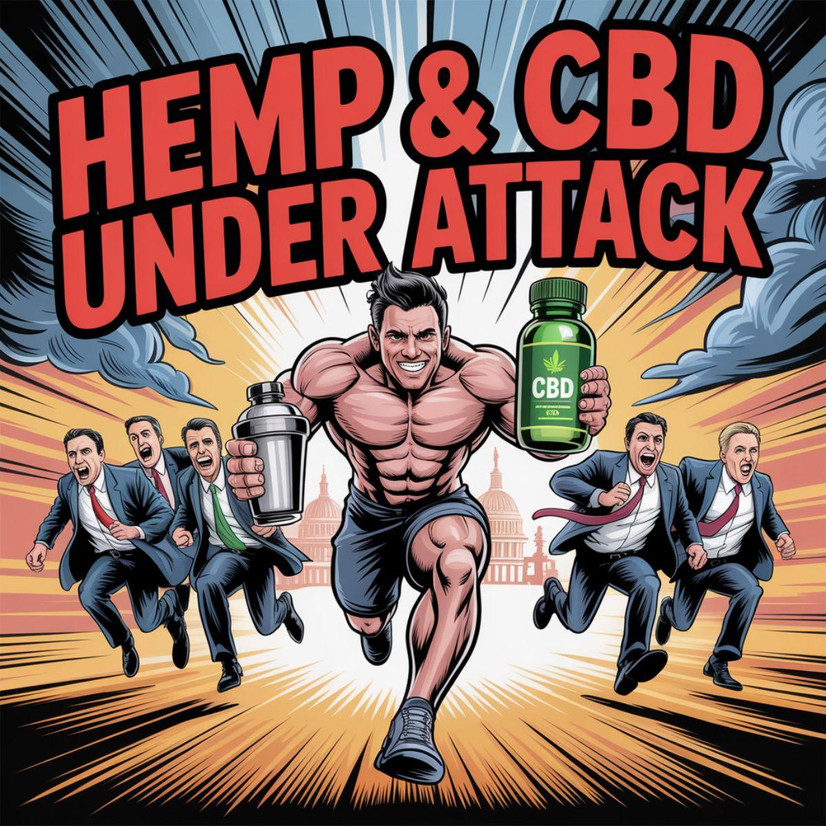
The Recent Hemp Ban
If you're in the fitness or supplement game, or just if you're a consumer who enjoys hemp or CBD products, you've likely seen hemp derived ingredients and CBD popping up everywhere from shops to preworkouts to protein powders and recovery blends as well as hemp and CBD drinks.
So when the Federal Government recently slipped in a major provision that will tighten the rules on hemp derived cannabinoid products, it's something everyone inthe space should pay attention to. This isn't just "cannabis policy" in a vacuum, it hits the supplement supply chain, farmer income streams, product formulations andmarketing andthe business of bringing a new ingredient to market. In recent years we've seen hemp/cbd/thc preworkout and protein powder companies popping up and this new legislation will kill those businesses as well as breweries, CBD Shops and more.
Background: The Rise of Hemp & CBD in Supplements
The legal famework for hemp in the US got a big boost with the Agriculture Improvement Act of 2018, better known as the 2018 Farm Bill. This bill legalized hemp, defined as cannabis with <0.3% Delta 9 THC by dry weight as an agricultural commodity.
This allowed the hemp and CBD industries to explode, farmers planted hemp, extractors pulled CBD and marketers began adding hemp derived cannabinoids to everything from wellness tinctures to fitness supplements and recovery products.
In the supplement space you started to see "hemp protein", "CBD + Recovery Blends", and "Hemp Derived Amino Acids" and similarly branded items for athletes, bodybuilders and gym goers. The idea hemp is natural and plant based with functional benefits made it a good marketing approach and appeal.
What Happenned? New Legislation & Hemp Ban Provision
Recently when Congress drafted the spending bill to reopen the Federal Government, a last minute provision was tacked in that dramatically narrowed what hemp derived cannabinoid products can legally be. Here are the key shifts...
- The deal would ban "the unregulated sale of intoxicating hemp based or hemp derived prodcuts, including delta-8, from being sold online, in gas stations and in corner stores"
- It would set a container threshhold of 0.4 milligrams of total THC per container for hemp derived cannabinoid products.
- It closes the so called "loophole" in the 2018 Farm Bill which allowed legal hemp (<0.3 Delta 9 THC) but also allowed extractors to produce other cannabinoids or higher potency products that still technically derived from hemp.
- Some say the bill effectively criminalizes many current hemp ingestible products (especially THC or delta-8 derived) because they wouldn't meet the new threshhold.
- The restriction reportedly would take effect about one year after enactment, giving some runway for adjustment.
Critics of the bill question what this has to do with a spending bill to re-open the Government and say if legislators wanted to ban hemp and hemp derived products they should have done it with it's own bill which could be debated, not snuck into a bill to re-open the government. Others question whether anyone will abide by this bill considering Marijuana is banned Federaly but nearly half of states, 24 states, ignore that law and allow for legalized Marijuana on a state wide level.
Which Proudcts Are Impacted?
In the supplement and fitness world, here are types of products that this legislative shift could affect or touch...
- Hemp derived protein powders or "hemp protein" blends thatalso carry minor cannabinoids or small THC residuals. While "industrial hemp" fiber/grain might be unaffected, any functional ingredient derived from hemp extracts would be scrutinized.
- Recovery and post workout blends that include CBD and other hemp derived cannabinoids such as CBD + CBG or minor cannabinoids, or contain extracts that may have trace THC above the new legal limit.
- Gummies or chewables aimed at athletes which claim "hemp infused" or "hemp and adaptogens" with minor cannaboinoid compounds. If there is THC content above the new container limit they could become non-compliant.
- Beverages and preworkout drinks with hemp derived cannabinoids (especially if they are marketed as having a "buzz" or functional effect). Many craft breweries or beverage makers have already flagged the alarm as many see 30% or more of their sales revenue from these drinks.
- Retail Channels ie gas stations, convenient stores, CBD shops and online shops which carry hemp derived ingestibles with higher cannabinoid content may face regulatory burdens or product pullbacks.
Effects on Farmers, Business & Supply Chains
The ripple effects could be serious...
- On the farming side many hemp farmers planted crops undre the assumption that CBD and related ingestibles would remain legal and viable and the ability to farm hemp was a lifeline to many struggling farmers. The n ew law threatens to wipe out a large portion of demand. Industry experts estimate the language could wipe out 95% of the industry.
- On the processor and manufacturer side, firms that extract cannabinoids, make gummies, beverages, and powders are looking at potentially huge compliance burdens, loss of market, and may need to pivot to industrial hemp fiber/grain rather than ingestibles.
- On the downstream retailers and supplement manufacturers, distributors and sellers may see products disappear, reformulate, or shift pricing. Smaller brands may struggle, and inventory risks rise. Store owners cliam this move could decimate the entire industry aside from licensed cannabis dispenseries.
- On the supply chain and development side, ingredients previously easy to source ie hemp extracts with minor cannabinoids may become harder to justify. R&D for new supplements and products will need to consider the regulatory risk.
- On the farmer side states like Kentucky, a major hemp state, will be especially destructive. For instance one advocate said "This will ultimately devastate the industry and devastate hemp farmers as well. Rand Paul has been particularly vocal about this recently.
What's the Purpose or Rationale Behind The Law?
Why did lawmakers do this? A few motivations...
- They aregue that the 2018 Farm Bill's definition allowed companies to exploit a loophole: legal hemp with <0.3% Delta 9 THC but then companies extract and concentrate, creating ingestibles like Dela-8, and other cannabinoids, beverages and gummies that can get people "high" and are distributed at gas stations and convenient stores.
- Concerns about youth acccess and public health. Some products marketed as edibles, gummies with candy-style packaging, and easy access in retail stores. Lawmakers say they need to close the "unregulated sale of intoxicating hemp derived products".
- A push from regulated cannabis industry and certain legislators to draw a sharper line between regulated marijuana markets and hemp derived ingestible cannabinoid market. Mitch McConnel (who supported hemp in 2018) now claism the industry is "unregulated" and has "increasing concerns for both drug enforcement and youth safety". The alcohol lobby has also heavily lobbied to have hemp and CBD products banned.
So from their view this is not purely about supplements or wellness, it's about controlling a rapidly evolving cannabinoid market, closing perceived loopholes, and protecitng certain public health interests.
What It Means Going Forward For the Fitness / Supplement Space
-
Ingredient diligence is essential: If you carry or develop hemp/CBD/hemp‑derived cannabinoid products, check the specification of THC (and total cannabinoid load) per container. Under the new law, anything above 0.4 mg total THC per container (or if considered “intoxicating”) may be non‑compliant.
-
Formulation pivot: Formulas that relied on “minor cannabinoids” (delta‑8, perhaps THCA, etc) or higher load hemp extracts may need reassessment. It may become safer to focus on non‑intoxicating CBD (though the law says it preserves non‐intoxicating products, but some industry groups argue many existing CBD products won’t meet the new threshold).
-
Marketing & claims risk: Be careful about positioning. If a product claims “buzz”, or “hemp high”, or uses minor cannabinoids, it may draw scrutiny. For athletes and fitness customers, you may want to emphasise purity, full‑spectrum vs broad‑spectrum, THC‐free, etc.
-
Retail channel changes: Some products may move out of gas stations/convenience stores and toward regulated retail or direct‑to‑consumer. This may affect visibility.
-
Supply & cost implications: With fewer legal ingestible options, ingredient costs may go up. Some brands may exit. This could reduce competition—but also create opportunity for brands that adjust early.
-
Opportunity in “compliance leadership”: Brands that brand themselves as fully compliant, third‐party tested, THC‑free or ultra‑low THC, athlete‑safe (e.g., for doping‑concerned customers) can differentiate. Given the shakeup, being ahead of the curve may give you a competitive advantage.
-
Watch the timeline & modifications: The law reportedly gives around a year for the full limit to take effect (so there’s a runway). The Washington Post+1 You might use that time to review formulas, inventory, supplier agreements. Also keep an eye on states: some states may adopt stricter rules or interpret differently.
Wrapping Up
In short, headlines about a hemp ban are accurate in the sense that the proposed federal funding bill includes language that will dramatically constrain what ingestible hemp derived cannabinoid products can legally contain (especially THC) and how they can be sold.
For the fitness and supplement space that means oneof the fastest growing ingredient categories is entering uncertain terrain. But uncertainty also equals opportunity for brands that monitor the legal shifts, stay compliant, pivot quickly, and communicate proactively with customers.
†The content of this blog post is intended solely for reference and entertainment purposes. We do not offer medical advice or specific guidance regarding the products discussed. Our insights are based on a combination of anecdotal experiences, online studies/reviews, manufacturer details, and customer feedback. While we strive to present accurate and current information, we cannot assure its completeness or its alignment with the most recent product formulations or data. For any concerns or up-to-date information, we recommend visiting the manufacturer's website directly. The opinions and information provided here do not necessarily reflect the views of Best Price Nutrition; they represent the perspectives and information from the manufacturers and users. Furthermore, these statements have not been evaluated by the Food and Drug Administration. The products mentioned are not intended to diagnose, treat, cure, or prevent any disease or illness.
Recent Posts
-

Pain-RX The Ultimate Solution for Natural Pain Relief
What is Pain-RX? Pain-RX is a supplement for natural pain management. Unlike typical over the counte
-
What is ACP-105?
Is ACP-105 The Ultimate Recomp SARM? ACP-105 is a Selective Androgen Receptor Modulator or SARM. It
-
Nurri Announces All New Nurri Protein Coffee Creamer Coming Soon
Nurri Protein Drinks came out of nowhere last year to quickly become one of the fastest growing and